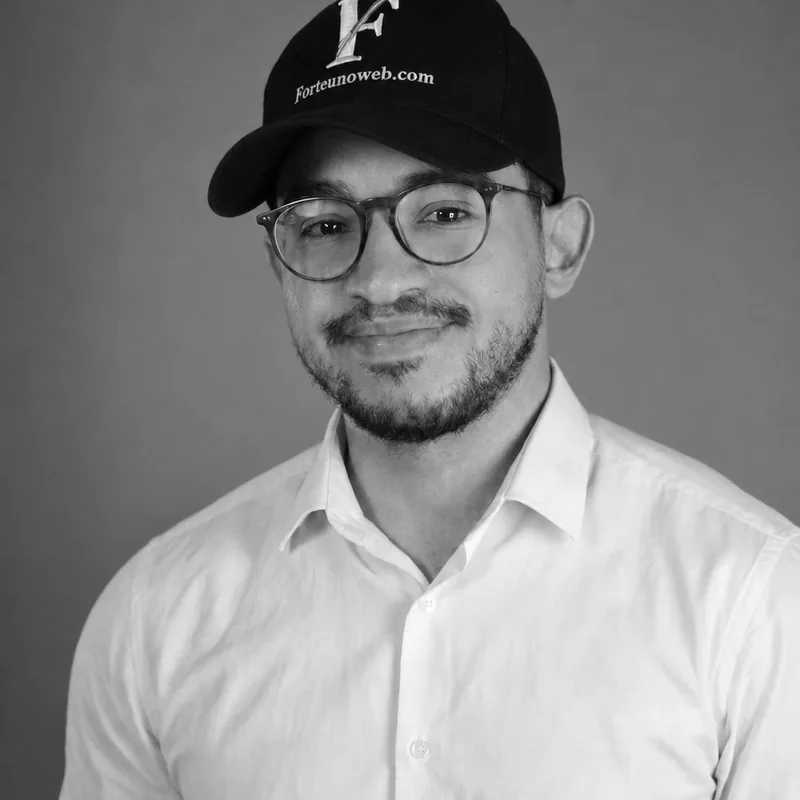
Mohamed Amine Saada
Co-founder and AI Engineer at Forteuno Web
I studied a double degree in Saint-Étienne, France, and spent my last three years there freelancing on AI projects for clients abroad. I came back to Morocco afterward to build something of my own: freelancing for US companies while building an AI customer-support service for local clinics in parallel. That is where I met Dr. Khalil Jarrar, and we started Forteuno Web so my work in AI and automation and his vision could become solutions for customers. I focus on getting a reliable result in the real workflow first, then improving speed and cost once the quality is proven.
How I approach AI automation
Technical teams often move to fine-tuning too early. In many customer-support systems, the missing piece is not a newly trained model. It is a small set of strong examples written by people who know the job. Those examples should show the reasoning, the tools used, the expected action and the meaning of important terms.
I also avoid using an AI agent because it sounds impressive. A rigid workflow should handle the steps that need a predictable result. AI should enter where language, ambiguity or judgment makes fixed rules insufficient. This usually creates a system that is cheaper, easier to inspect and less likely to break. If a process has no defined standard to begin with, adding AI on top does not fix that problem. It usually just makes the failure harder to see.
The latest model is not automatically the best model. I benchmark models on the exact task, including error rate, tone, tool use and cost. I first reach the quality target, then optimize the cost. Trying to optimize both before the system works makes it harder to understand why the result is failing.
In practice I build with LangGraph and LangChain in Python, containerized with Docker. OpenAI is my default model provider, since it gives the most consistent results for the cost across most of my projects, though I switch to local models when a client needs strict data privacy or a specific latency profile. For automations a client wants to see and edit themselves, I build in n8n instead of custom code.
Moroccan dental SaaS experience
The dialect problem was solved with real examples
While building a customer-support SaaS for dentists in Morocco, I initially expected a local model and fine-tuning to be the answer. The stronger fix came from few-shot examples collected with real dental assistants and based on their day-to-day experience. The agent improved because it received the right example for the current situation, not because we trained a model from scratch.
That lesson now shapes Forteuno Web projects for dental practices: start with the real conversations, define the safe boundary, route each request to the right workflow and keep a human in control of clinical decisions.
Explore Forteuno Web solutions in Morocco →